
Your shopping cart is empty!
Categories
Bestsellers
Live Chat
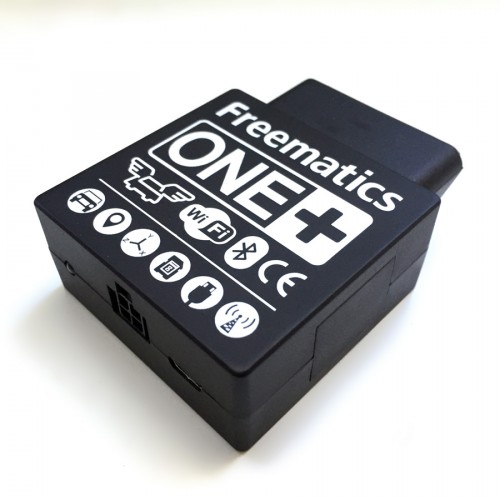
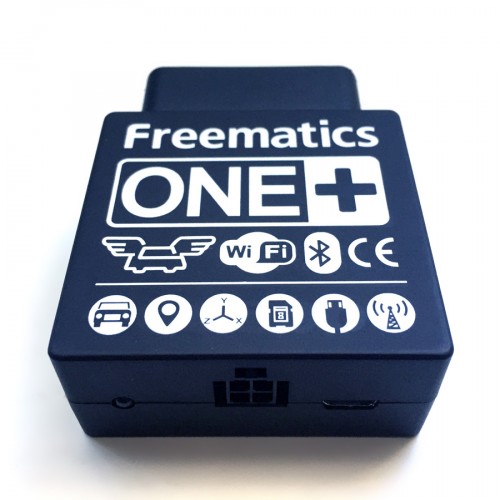
Freematics ONE+ Model B
Price: US$135.00
Qty:
- OR -
Add to Wish List
Add to Compare
Add to Compare
Programmable OBD-II telematics hardware with ESP32, 4G LTE, GNSS, CAN bus access, and microSD logging.
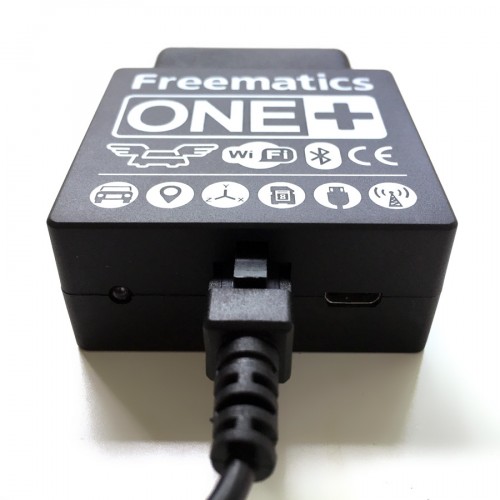
Freematics ONE+ Model B is a compact, programmable OBD-II device designed for vehicle telemetry, data logging, GPS tracking, CAN bus monitoring, and connected automotive projects. It plugs directly into a vehicle’s OBD port and integrates an ESP32 MCU, 4G LTE cellular module, GNSS receiver, motion sensor, microSD storage, Bluetooth, Wi-Fi, and useful onboard peripherals in a single enclosure.
Whether you are building a fleet-tracking prototype, an automotive data logger, a cloud-connected telematics device, or a custom vehicle monitoring solution, Freematics ONE+ Model B gives you a ready-to-program hardware platform without requiring you to build the electronics from scratch.
Key Features
- Arduino-programmable ESP32 platform with dual-core processing, Wi-Fi, and Bluetooth
- Direct OBD-II access for standard PIDs, diagnostic trouble codes, VIN, and vehicle ECU data
- CAN bus sniffing for advanced vehicle data monitoring
- Integrated GNSS for high-update-rate vehicle positioning
- Integrated 4G LTE cellular connectivity for real-time data transmission
- Motion sensing for G-force measurement, movement detection, and low-power monitoring
- Vehicle battery voltage reading through the OBD connection
- microSD storage support for local data logging
- BLE app connectivity for configuration and monitoring from a mobile device
- External I/O socket for connecting sensors, controllers, or custom peripherals
Hardware Overview
Specifications
- Espressif ESP32 with 16MB Flash, 8MB PSRAM, 32K RTC
- Built-in 802.11 b/g/n Wi-Fi
- Dual-mode Bluetooth, including Classic Bluetooth and BLE
- Integrated ICM-42627 motion sensor
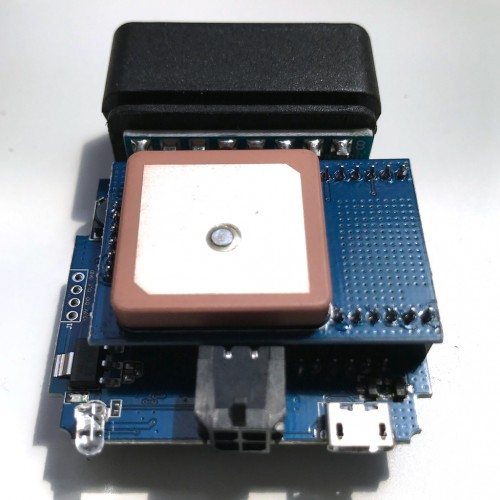
- Integrated u-blox M9 GNSS module and antenna
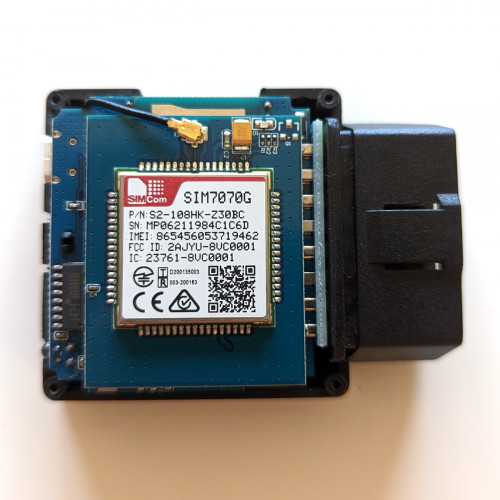
- Integrated SIM7670 LTE CAT-1 cellular module
- Built-in buzzer
- Compact enclosure: 60 × 48 × 20 mm
Physical Interfaces
- OBD-II male connector
- microUSB port
- microSD card slot
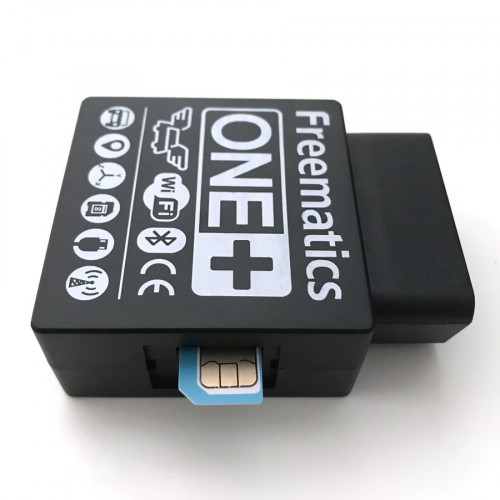
- SIM card slot
- GPIO socket (Molex)
OBD-II Compatibility
Freematics ONE+ plugs directly into the OBD port, which is usually located under the steering column. It supports common OBD-II vehicle protocols and can access standard diagnostic and vehicle telemetry data from compatible ECUs.
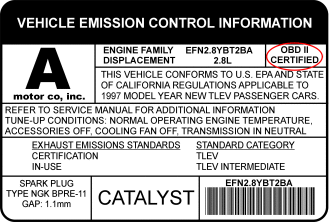
Vehicles using following vehicle protocols are supported.
- CAN 500Kbps/29bit
- CAN 250Kbps/29bit
- CAN 500Kbps/11bit
- CAN 250Kbps/11bit
- KWP2000 Fast
- KWP2000 5Kbps
External I/O
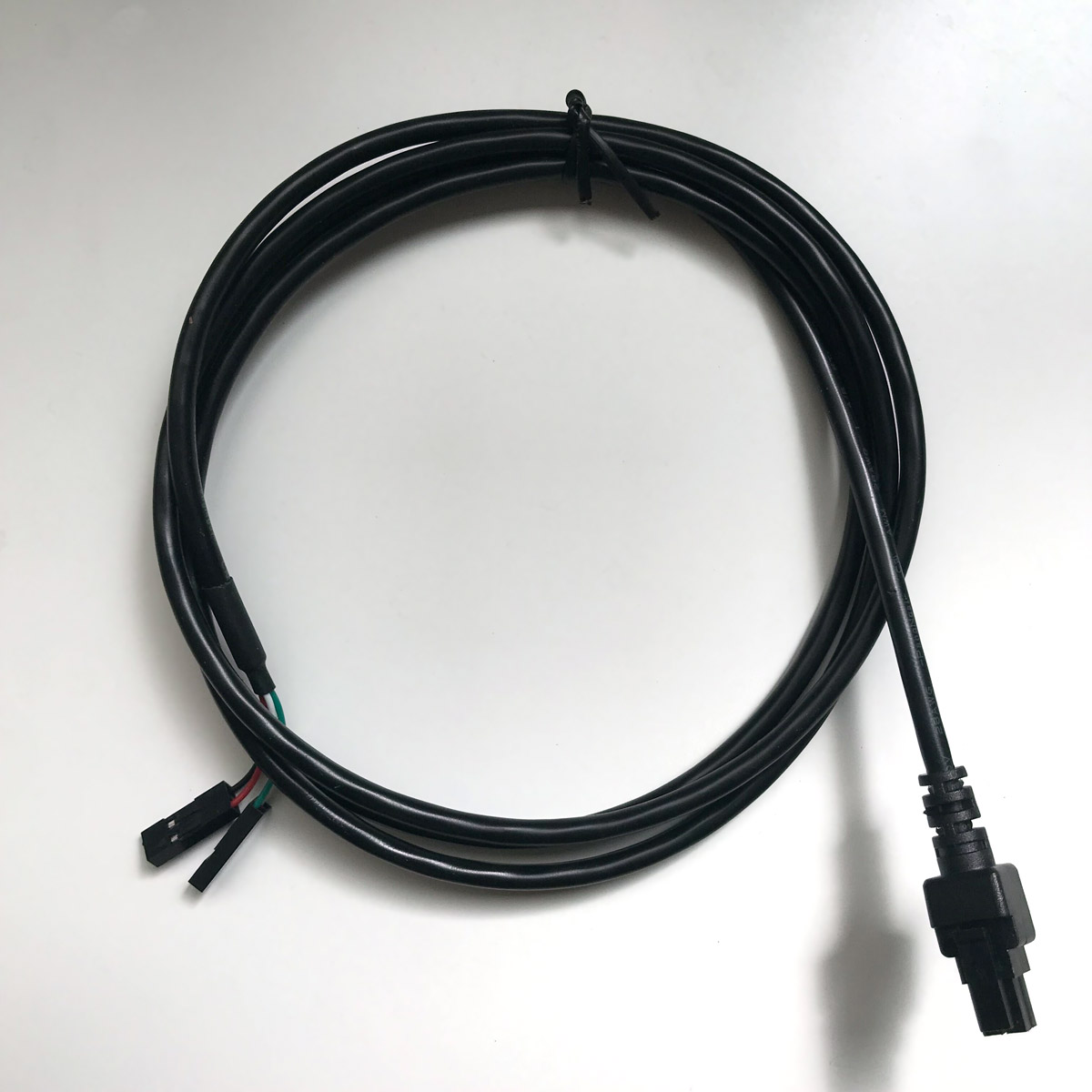
Freematics ONE+ Model B includes a 4-pin external I/O socket for connecting additional sensors, controllers, or custom hardware. The socket provides two ESP32 GPIO pins, controllable VCC, and GND.
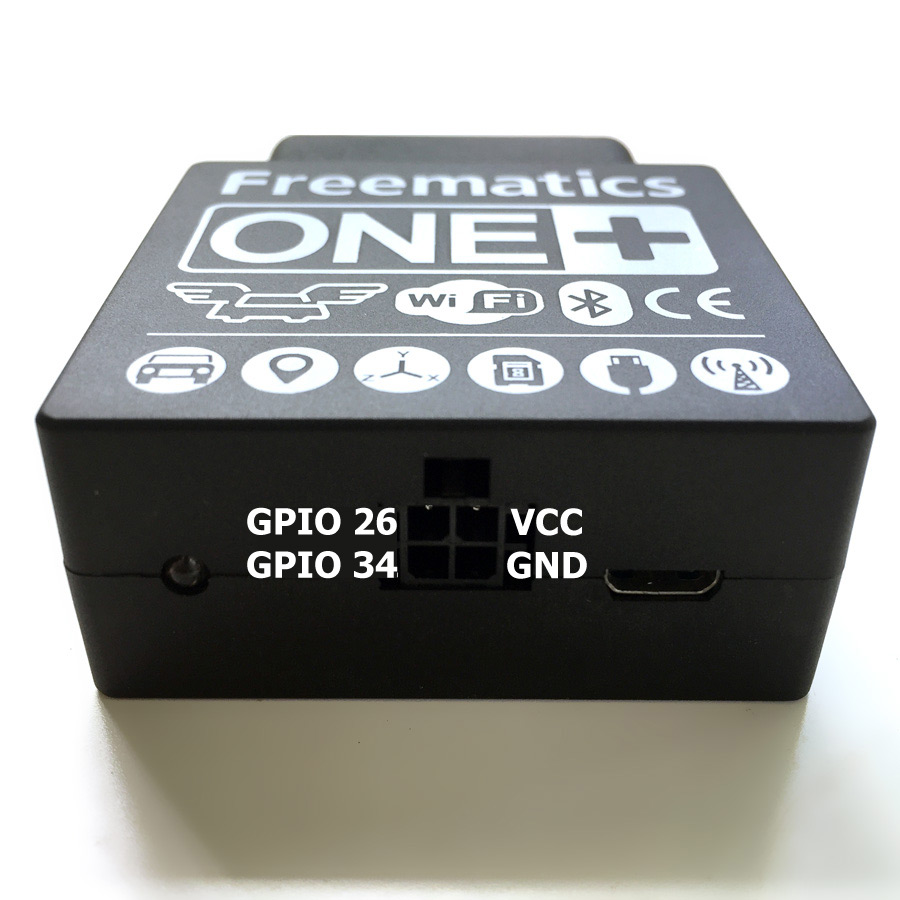
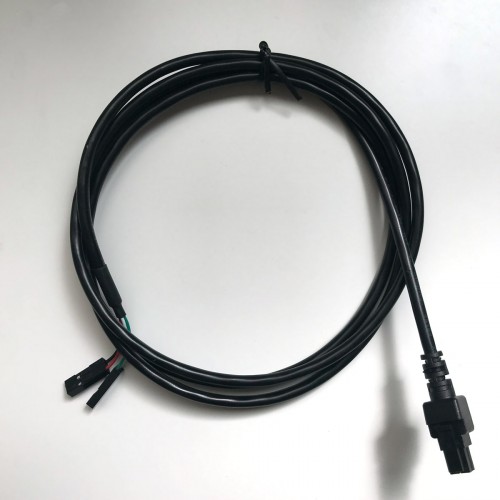
With a Molex-to-2.54mm Dupont conversion cable, you can easily connect external components during prototyping or product development.
Dupont connector wiring:
- Green: GPIO26
- Black: GND
- Red: VCC
- White: GPIO34
GNSS Positioning
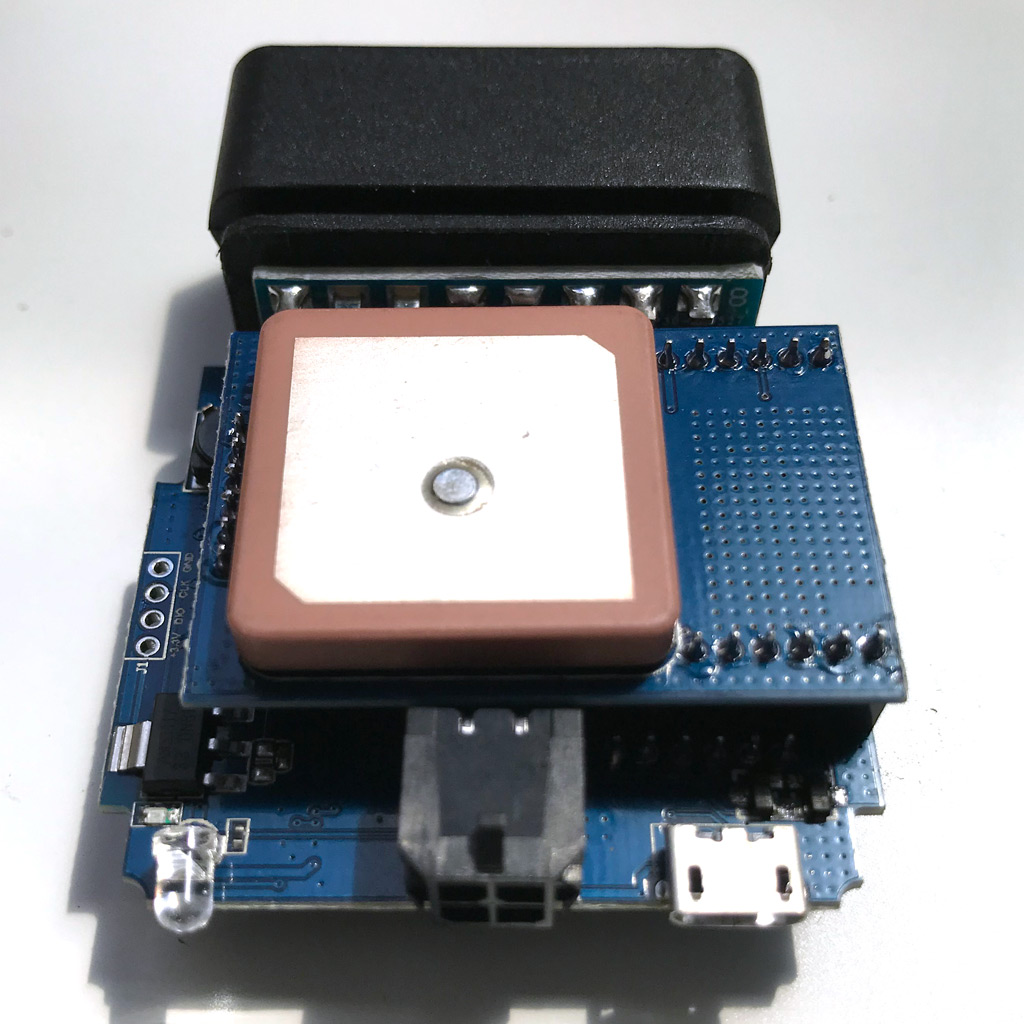
Freematics ONE+ Model B integrates a u-blox M9 GNSS module with an active ceramic antenna for vehicle positioning. The GNSS module can be configured programmatically, while NMEA data is decoded in real time by the co-processor and made available to the ESP32 for logging, processing, or transmission.
Bluetooth and Mobile App Support
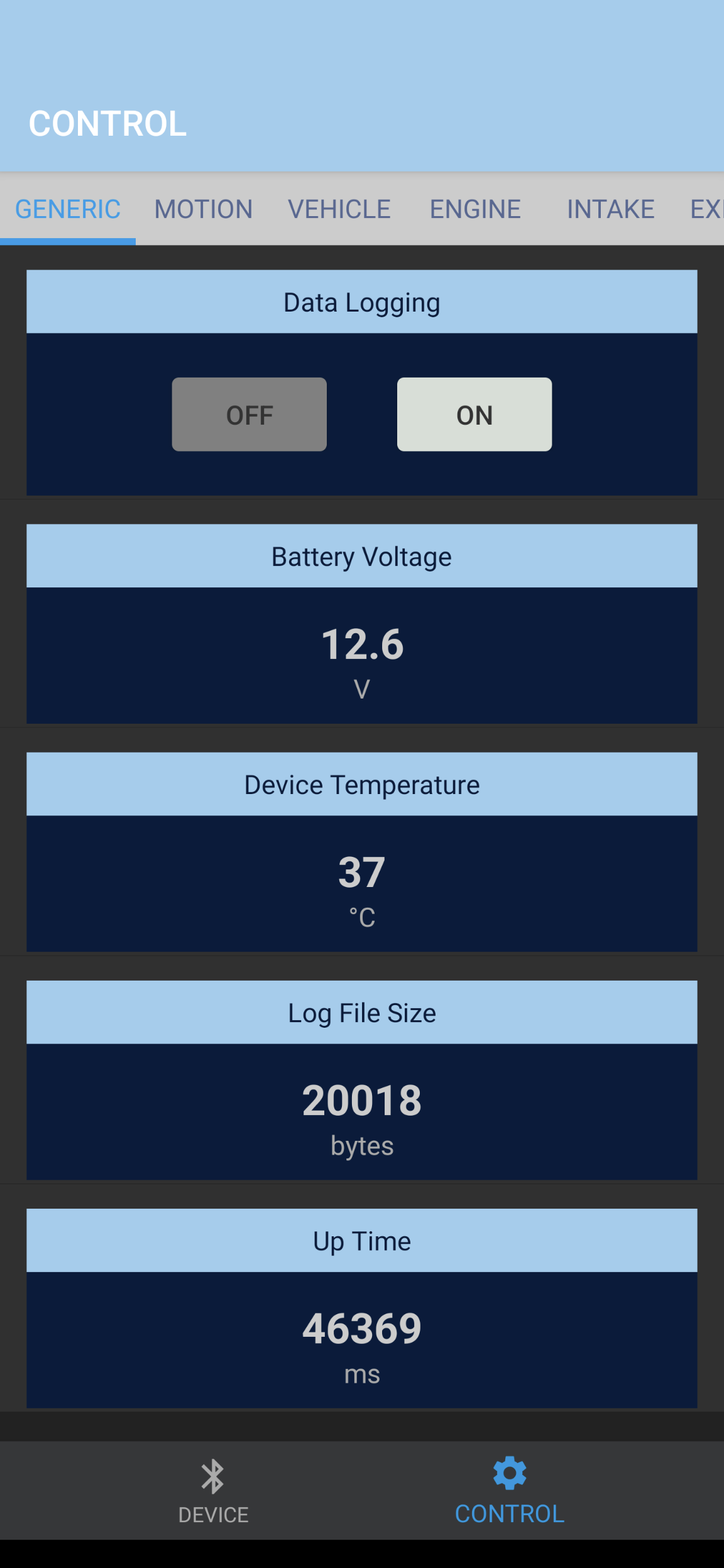
Freematics ONE+ includes dual-mode Bluetooth capability and can connect to the Freematics Controller App over BLE when using the supported datalogger sketch or telelogger sketch. This allows the device to be configured and monitored from a mobile device without needing a wired connection.
Cellular Module
Model B includes an integrated SIM7670 LTE CAT-1 cellular module for transmitting vehicle data over mobile networks.
Supported LTE Bands
LTE-FDD: B1 / B2 / B3 / B4 / B5 / B7 / B8 / B12 / B13 / B18 / B19 / B20 / B25 / B26 / B28 / B66 / B71
LTE-TDD: B34 / B38 / B39 / B40 / B41
Data Transfer Speed
- Download: up to 10Mbps
- Upload: up to 5Mbps
SIM Card
A microSIM card is required to use cellular network connectivity. Insert the SIM card into the slot as shown below.
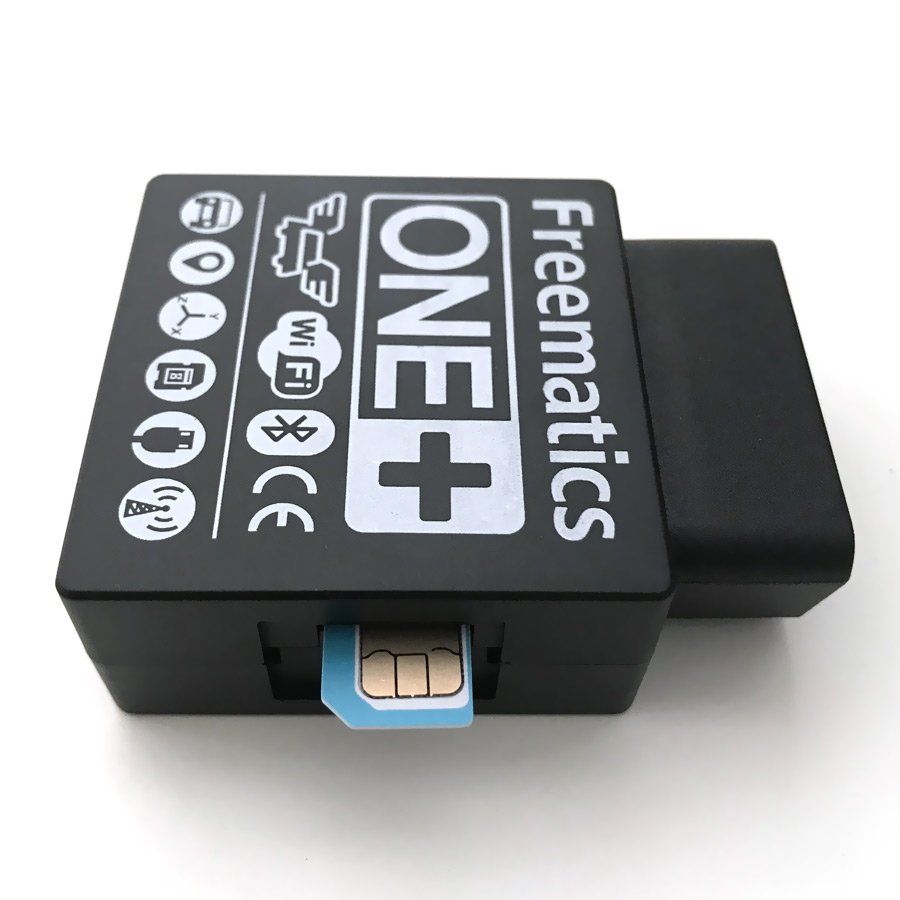
Global SIM cards like Hologram IoT SIM card are supported.
MicroSD
The built-in microSD slot is connected to the ESP32 via SPI and can be accessed using the standard Arduino SD library. This makes it easy to log OBD data, GNSS coordinates, sensor readings, and diagnostic information locally.
Buzzer
The internal buzzer is connected to ESP32 GPIO25 and can be driven using PWM or DAC output. It can be used for alerts, status feedback, or user interaction in custom applications.
Low-Power Mode
Freematics ONE+ can enter and exit low-power mode programmatically. When GPS, cellular, and Wi-Fi are powered off, power consumption is around 10mA. This helps reduce vehicle battery drain while still allowing the main controller to run lightweight tasks such as motion detection through the onboard MEMS sensor.
Model Comparison
| Model B | Model A | |
|---|---|---|
| RAM Configuration | 520KB IRAM + 8MB PSRAM | 520KB IRAM |
| RTC | External 32K | Built-in (less accurate) |
| Cellular Module | Integrated 4G LTE module | Optional cellular module |
| GNSS | Integrated M8030 10Hz GNSS module and antenna | Via external GNSS receiver |
| External I/O | 2x GPIO for digital I/O, analog input, serial UART etc. | Occupied if GNSS receiver is connected |
| Co-Processor Features | Vehicle ECU interfacing GNSS data processing |
Vehicle ECU interfacing |
Development
Freematics ONE+ Model B is designed for developers who want to build custom vehicle-connected products without starting from bare hardware.
Freematics provides a dedicated Arduino library for accessing the device’s hardware resources, along with functional reference Arduino sketches for common use cases. With basic Arduino knowledge, you can begin collecting vehicle data, logging it to microSD, reading GNSS coordinates, transmitting data over cellular or Wi-Fi, and building your own automotive applications.
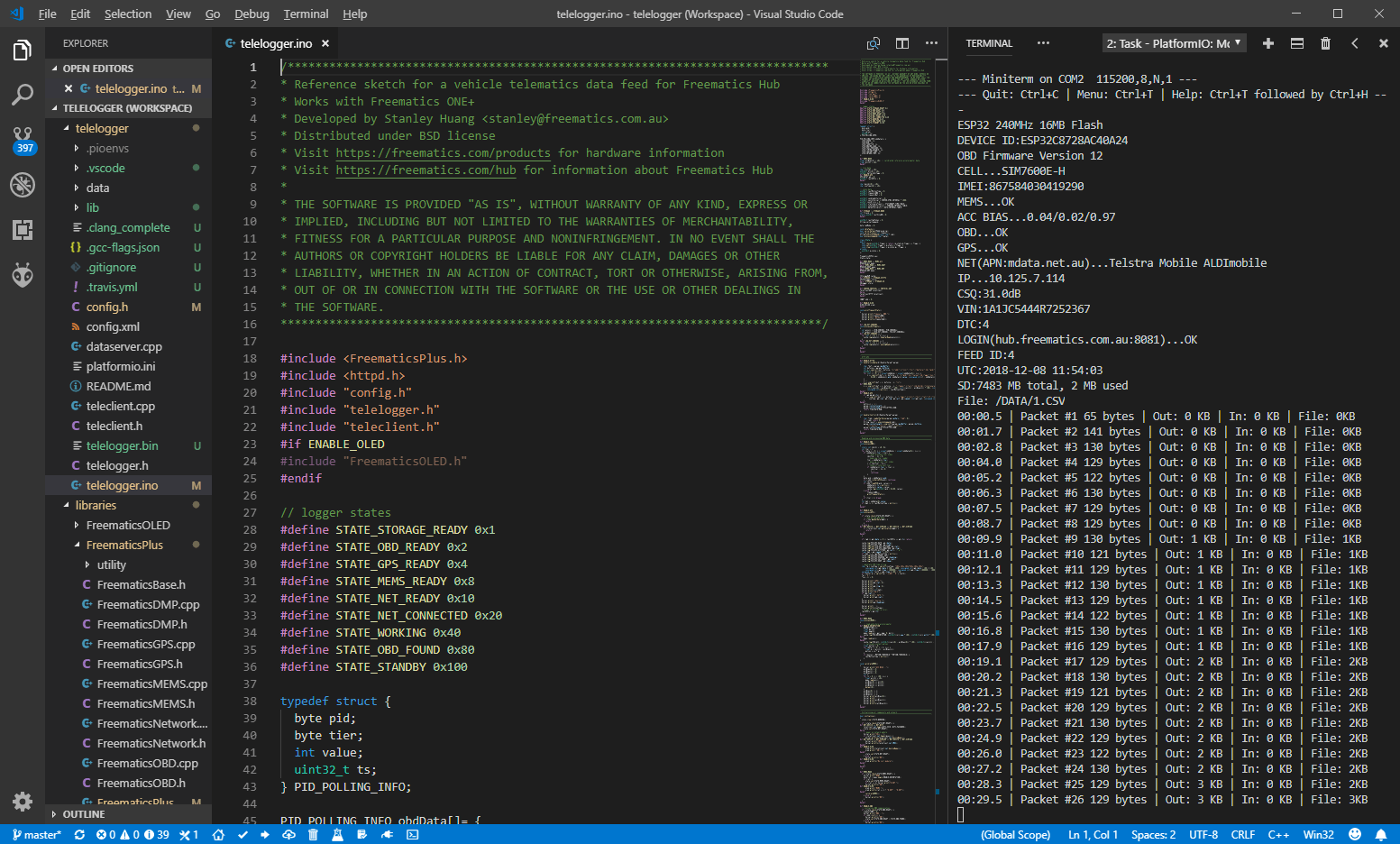
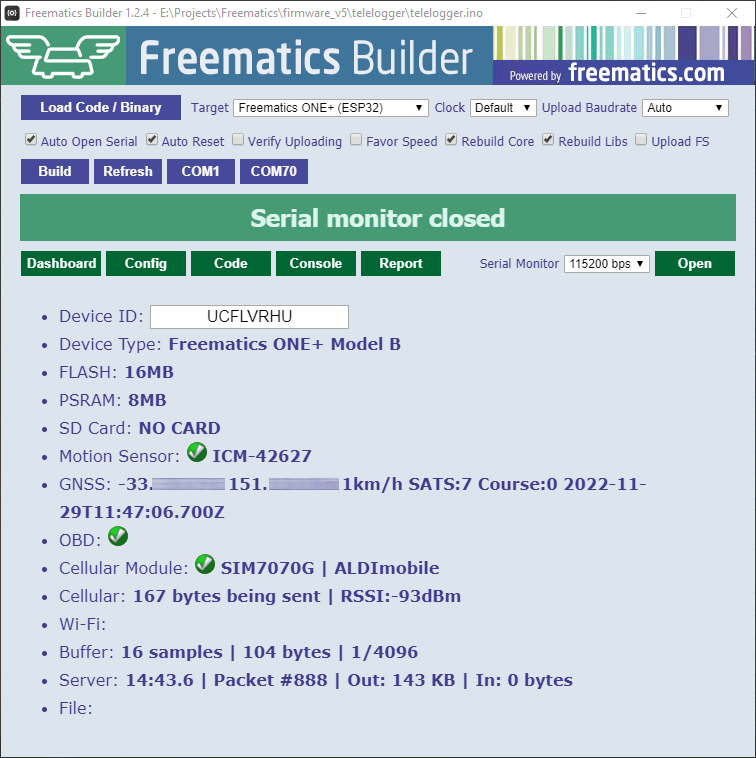
For a simpler development workflow, Freematics Builder provides a graphical interface for configuring, compiling, and uploading Arduino sketches. Advanced users can also develop with PlatformIO, Arduino IDE, Arduino makefile, or ESP-IDF-based workflows.
For setup instructions and development details, refer to the Developers Guide.
Useful Links

Powered By OpenCart
Freematics Store © 2026
Freematics Store © 2026